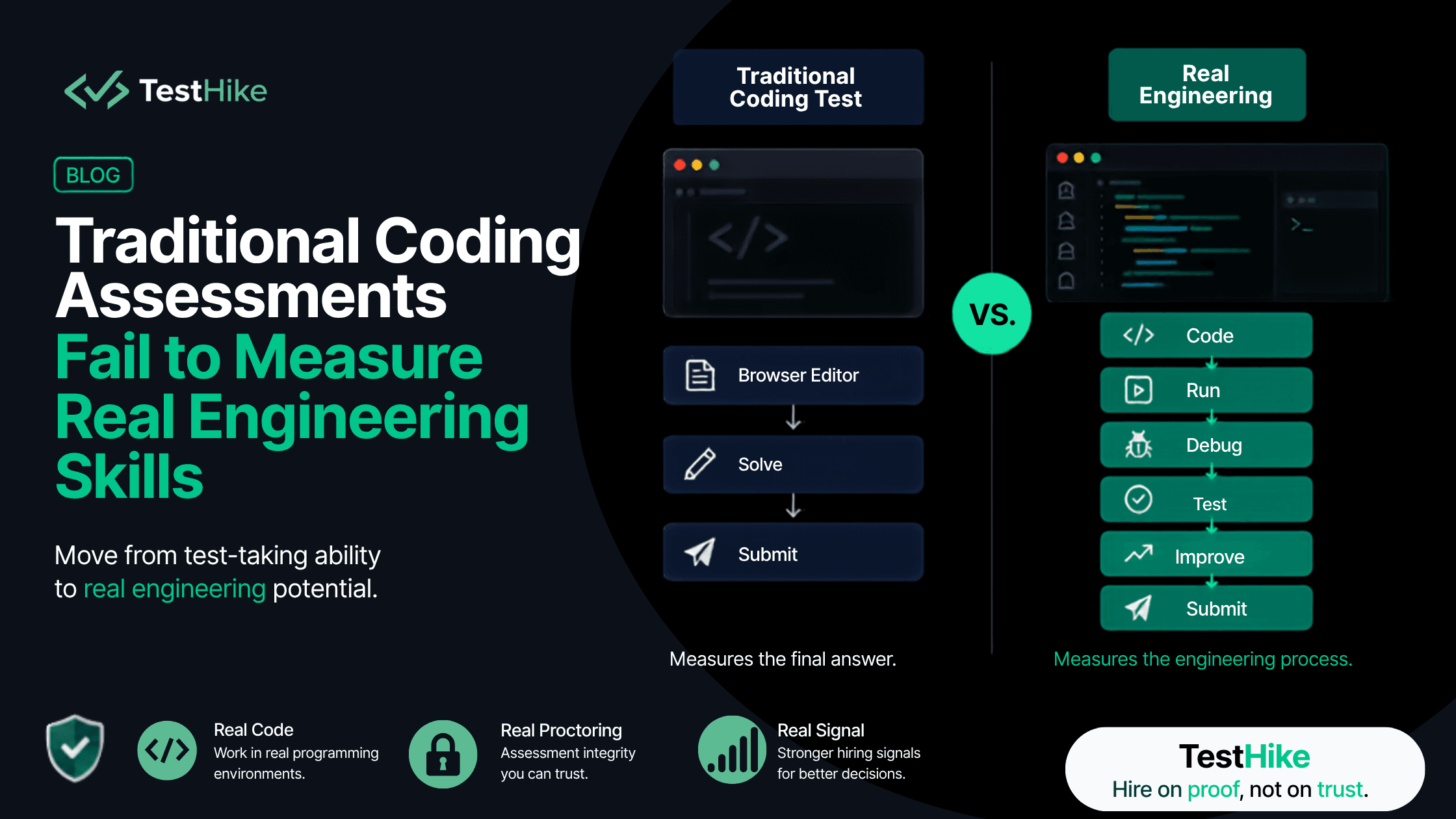
Why Traditional Coding Assessments Fail to Measure Real Engineering Skills
A candidate solves the coding challenge.
All the test cases pass.
The score looks good.
But can they actually build software?
This is one of the biggest questions hiring teams face when evaluating developers and engineers.
Traditional coding assessments have become a common part of technical hiring. They can help companies evaluate programming knowledge, problem-solving ability, and familiarity with algorithms and data structures.
But there is a problem.
A developer's ability to solve an isolated coding challenge does not always tell you how they will perform when working on real software.
Real engineering is rarely just:
Read a problem → Write a solution → Submit
It is much closer to:
Understand → Code → Run → Fail → Debug → Test → Improve → Submit
That difference matters.
For engineering managers, technical recruiters, CTOs, and hiring teams, the goal of a coding assessment should not simply be to determine whether a candidate can produce the correct answer.
The goal should be to collect enough evidence to understand how that candidate actually approaches engineering problems.
The Problem With Traditional Coding Tests
Traditional coding tests are useful for measuring certain technical skills. However, they can sometimes create a gap between the assessment experience and the work developers are expected to perform.
Algorithm Memorization Can Become the Focus
Many coding assessments are built around algorithmic challenges.
Candidates may be asked to solve problems involving data structures, algorithms, optimization, or specific programming concepts.
These skills are valuable.
But knowing how to solve a particular algorithmic problem does not automatically mean someone can effectively work on a production codebase.
Real software development requires engineers to understand requirements, work with existing code, identify problems, debug unexpected behavior, write tests, and make decisions about how a solution should be implemented.
A coding assessment should therefore look beyond whether a candidate remembers a particular approach.
Artificial Assessment Environments Can Limit What You Observe
The environment in which a candidate completes an assessment affects the type of behavior a hiring team can evaluate.
A simplified browser editor can make the assessment convenient, but it may not resemble the environment developers normally use to write and test software.
When the environment is highly restricted, hiring teams may see only the final answer.
They may not get enough insight into how the candidate approaches the development process itself.
Debugging Is Part of Engineering
Code does not always work on the first attempt.
Developers write code.
They run it.
Something fails.
They inspect the error.
They change the implementation.
They test again.
They improve the solution.
This process is normal in software engineering.
An assessment that focuses primarily on the final submitted answer may miss an important part of a developer's problem-solving process: how they respond when their first solution does not work.
Day-to-Day Engineering Is More Than Solving Isolated Problems
Professional software development involves much more than completing individual programming challenges.
Engineers work with requirements, existing systems, technical constraints, testing, debugging, performance considerations, and changing requirements.
The closer an assessment gets to realistic development behavior, the more useful the resulting hiring signal can become.
Passing a Coding Test Isn't the Same as Being a Strong Engineer
A candidate can be excellent at solving coding challenges and still struggle in a real engineering environment.
Likewise, a candidate may not produce the fastest possible solution immediately but demonstrate strong debugging skills, logical thinking, code quality, and engineering judgment.
This does not mean coding tests are useless.
It means the result needs context.
A strong technical assessment should help answer questions such as:
Can the candidate understand the problem?
Can they translate requirements into working code?
Can they identify and fix errors?
Can they test their solution?
Can they improve their implementation?
Can they make reasonable engineering decisions?
Can they produce correct and maintainable code?
These questions provide a much broader picture than simply asking whether all test cases passed.
What Real Engineering Work Looks Like
Think about what happens when an engineer receives a new development task.
They first need to understand the problem.
Then they begin writing code.
They run that code.
Something may not work as expected.
They investigate.
They debug.
They test individual parts of the implementation.
They make improvements.
They run the solution again.
Eventually, they arrive at a working solution that meets the requirements.
The process looks something like this:
Write Code → Run → Encounter Errors → Debug → Test → Improve → Submit
That process is important because engineering ability is not only about knowing what the final answer should look like.
It is also about knowing how to get there.
A realistic coding assessment can give hiring teams more opportunities to observe these behaviors.
What Should Hiring Teams Measure Instead?
The answer isn't to make coding assessments harder.
The answer is to make them more meaningful.
Instead of focusing on a single outcome, hiring teams should consider multiple dimensions of technical ability.
1. Problem Solving
Can the candidate understand the requirements and break a problem into manageable steps?
2. Correctness
Does the solution actually solve the problem and handle the expected scenarios?
3. Debugging Ability
When something goes wrong, can the candidate identify the cause and fix it?
4. Code Quality
Is the implementation understandable, organized, and appropriate for the problem?
5. Testing Behavior
Does the candidate verify their work instead of assuming the first solution is correct?
6. Efficiency
Can the candidate consider performance and choose an appropriate approach?
7. Engineering Judgment
Can the candidate make sensible technical decisions based on the problem and its constraints?
These signals together can provide a stronger understanding of a candidate's technical ability.
Why the Assessment Environment Matters
The assessment environment is not just a technical detail.
It determines what hiring teams can actually observe.
Consider the difference between these two experiences.
Traditional Assessment
Read Problem → Write Solution → Submit
Real Engineering
Understand → Code → Run → Fail → Debug → Test → Improve → Submit
The second process provides more opportunities to evaluate how someone works.
This is why the environment used for a coding assessment deserves more attention.
If the assessment environment does not resemble real development, hiring teams may end up evaluating test-taking ability rather than engineering ability.
A realistic coding environment can create a more meaningful assessment experience by allowing candidates to work through problems in a way that is closer to actual development.
Realistic Doesn't Mean Uncontrolled
There is an important balance to maintain.
Making an assessment more realistic does not mean removing assessment integrity.
Hiring teams still need confidence that the results represent the candidate's own work.
This is where secure assessment and proctoring become important.
A technical assessment can provide candidates with a more realistic coding experience while still giving hiring teams assessment-integrity signals.
The goal should not be to automatically label every unusual action as cheating.
Instead, assessment activity and integrity signals can give hiring teams additional context for human review.
This creates a better balance:
Realistic enough to measure engineering ability
Secure enough to provide trustworthy hiring signals
Automated Grading Creates Consistent Results
Another important part of technical assessment is consistency.
When hiring teams evaluate a large number of candidates, manually reviewing every solution in exactly the same way can be difficult.
Automated grading can help create a more consistent evaluation process.
Instead of relying entirely on subjective impressions, hiring teams can use structured scoring and assessment results alongside other signals.
This can make technical screening more scalable while helping teams compare candidates using consistent criteria.
The important point is that automated grading should support the hiring decision, not replace engineering judgment.
A score is useful.
But the context behind that score is what makes it meaningful.
The Goal Isn't to Test Candidates Harder
A better technical assessment does not necessarily mean a longer or more difficult test.
The objective should be to collect better evidence.
Hiring teams should ask:
Are we testing something relevant to the role?
Does the assessment reflect the type of work the candidate will actually perform?
Can we observe problem-solving and debugging?
Are we evaluating more than the final answer?
Does the assessment environment allow us to collect meaningful signals?
Does the process remain secure and consistent?
These questions can help transform technical screening from a simple filtering exercise into a more useful engineering evaluation.
From "Did They Pass?" to "What Did We Learn?"
This is perhaps the most important shift in technical hiring.
Instead of asking:
"Did the candidate pass the coding test?"
Hiring teams should ask:
"What did we actually learn about this candidate's ability to do the job?"
A passing score is one data point.
Real engineering ability is broader.
It involves problem solving, coding, debugging, testing, correctness, code quality, efficiency, and engineering judgment.
The more of these behaviors an assessment can meaningfully evaluate, the stronger the hiring signal can become.
How TestHike Approaches Technical Assessments
TestHike is built around the idea that technical assessments should provide stronger evidence of real engineering ability.
Instead of treating coding as simply:
Solve → Submit
TestHike focuses on a more realistic assessment experience:
Code → Run → Debug → Test → Improve → Submit
The platform provides a desktop-based coding assessment environment where candidates can work with real programming environments while hiring teams receive assessment results and activity information.
TestHike also supports secure assessment workflows designed to provide assessment-integrity signals while keeping the assessment experience practical for candidates.
For hiring teams, the objective is simple:
Collect meaningful technical evidence before making a hiring decision.
Because a resume tells you what someone has done.
An interview tells you how they communicate.
But a well-designed technical assessment can show you how they approach a technical problem.
A Better Standard for Technical Hiring
Technical hiring is changing.
As software engineering becomes more complex, hiring teams need better ways to evaluate technical ability.
The answer is not necessarily more difficult coding challenges.
It is a better assessment design.
It means creating assessments that measure relevant skills, provide realistic coding experiences, maintain assessment integrity, and give hiring teams useful evidence for decision-making.
The question is no longer simply:
"Can this candidate pass a coding test?"
It is:
"Can this candidate demonstrate the engineering skills needed for the job?"
That is the difference between testing for a score and assessing for signal.
Final Thoughts
Traditional coding assessments can be useful, but they do not always capture the full picture of engineering ability.
A developer's work is rarely just about writing the correct answer.
It is about understanding a problem, writing code, running it, dealing with errors, debugging, testing, improving the solution, and making sound engineering decisions.
That is why the assessment environment matters.
The better the assessment reflects meaningful engineering behavior, the more useful the evidence can become for hiring teams.
At TestHike, we're working toward a simple idea:
Hire on proof, not on trust.
Real Code. Real Proctoring. Real Signal.
If your technical hiring process is still focused primarily on whether candidates can pass coding challenges, it may be time to ask a different question:
Are you measuring coding ability or are you measuring the ability to take a coding test?
Explore TestHike and rethink how you evaluate technical talent.